
Fermented Grains: The Perpetual Soured Porridge Pot
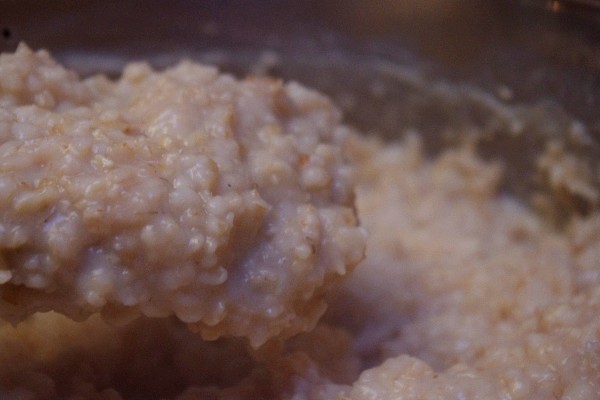
One thing I have found since we moved off-grid is that we simply need to eat more filling, hearty, and dare I say starchy foods. When we first got here that was simply bread and butter, corn tortillas, or plain old oatmeal.
Now that my cooking situation is a bit more set up I have been getting back to soaking and fermenting grains. The problem is that our cabin can swing drastically from 70-some degrees during the day and 30-some degrees at night, which would be why my sourdough starter just wouldn’t cut it.
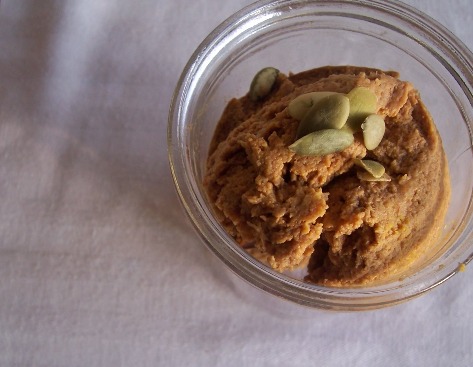
So I decided to give our oats a ferment and see what happened. The results have been great and dare I say low-maintenance, surviving even in our crazy climate and with my lack of daily feedings. The porridge is definitely sour in flavor, but we love it with plenty of butter, fruit, nuts, and raw milk.
Why Fermented Grains?
Over the years I have found that our bodies tend to digest and simply use grains better if they are soaked, but preferably fermented. This has been the case with a sourdough bread vs. a regular yeast bread and now with this porridge.
Fermentation breaks down the hard to digest components of grains and tends to maximize the nutrients of whatever food is being fermented. Win-win.
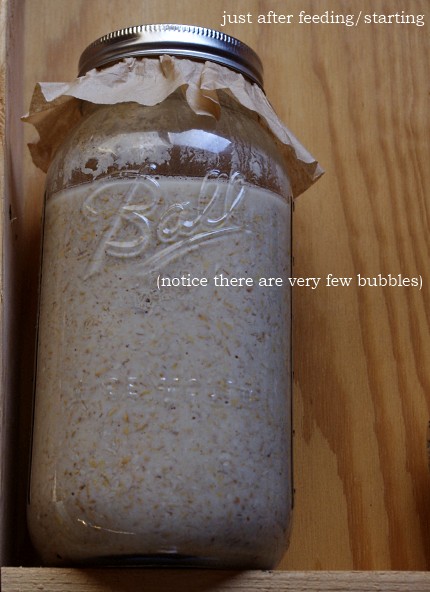
Here is How I Made the Starter:
- Crack whole oat groats into something like a steel-cut oat. It will look like a combination of flour and pieces of whole oats. You can grind it as fine as you’d like, just make sure the oat groats have been broken up and the starchy insides exposed.
- Combine a few cups of these (I just use two scoops from our grain bucket, the equivalent of about 2-3 cups) with enough water so that you can stir it easily but it is not too soupy. I use a half gallon jar for this.
- You can, optionally, add some whey at this point to kick-start the fermenting process. I did just a couple of tablespoons off of our kefir and it seems to have worked well.
- Cover with a cloth or a coffee filter and a rubber band or canning ring. Let sit in a warm place for a few days or until it starts to smell sour and have little bubbles.
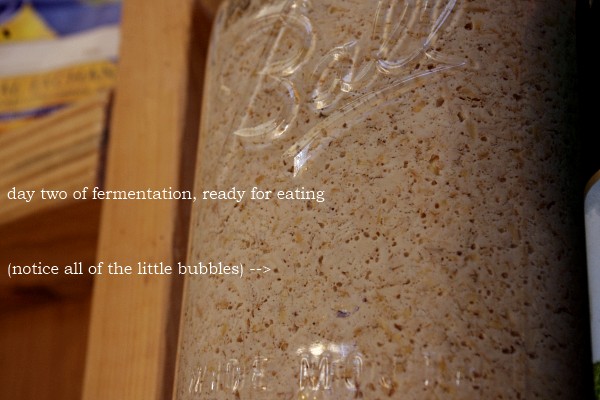
Here is How I Feed It:
Every time we make and use up all but one cup of the porridge my five-year-old cracks two more scoops of oats and I stir them into the jar, being sure to incorporate a good amount of air.
I let this ferment for about two days before removing all but one cup and feeding the porridge once again. I’ve gone longer than those two days between eatings and feedings, but I find the sourness is tamed by using it up within a couple of days (assuming it has already soured).
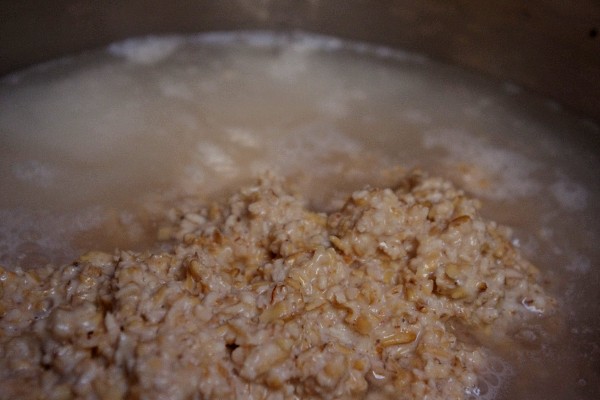
Here is How I Use It:
Be sure to leave 1 cup of porridge in jar. Combine the desired amount of soured porridge with enough water to cover by 1-2". Cook slowly over low heat, stirring frequently, until thick and water is absorbed.
You can also bake with this, which is something I am excited to share with you soon as well.
Learn More About Soaking, Sprouting, and Fermenting Grains
As we have started down this path towards agrarianism we find ourselves having to keep our grocery budget as low as possible while nourishing our bodies in order to do the physical work involved in starting a homestead. Spending the last five years learning about properly preparing grains, beans, and other foods has been an invaluable tool in making this little equation work.
If you are interested in learning more about turning those hard-to-digest grains into something nourishing then you may want to check out the Healthy Whole Grains e-course. This self-paced online class includes 50 videos and over 100 printable recipes to get you going.
Use the coupon code SPROUT20 by February 7th and receive a $20 discount on the course. I am told this is the only coupon code that will be made available to the public, so don’t delay!
Very informative! I’d like to try it, but I’ve never fermented grains before. Is this safe for me during pregnancy, or would it be best to try after baby has arrived?
Very useful – thank you. I usually soak my oatmeal overnight in water with yogurt added. This year we are planning to grow our own native oats, so I will give this a go. x
Julie, your gut flora (the bacteria in your insides) work for you, getting nutrients out of your food and fighting invading bacteria (ie illness). Fermented foods are like troop reinforcements for your friendly flora (while processed sugars and grains are ammunition for the bad guys). Your baby will receive your gut flora during the birth process, so the better your is the better theirs will be. Give ferments a try! If soured grains don’t taste quite right to you, try googling “lactofermentation” for recipes of other things you can make at home to help this along. Congratulations on your imminent arrival!
Very interesting post, thanks! What do you use to crack whole oat groats?
Can you use already steel cut oats for this process or does it need to be “freshly” cut oat groats?
I’m not sure what this would taste like without cooking – but wouldn’t it be a lot better for you raw because all the enzymes and probiotics wouldn’t destroyed by cooking? I’m not sure if it’s tasty enough to stomach raw – but I think I’ll give this a try and find out. I just wonder if you’ve ever tried it?
Petra – I haven’t tried it yet and I am wondering if it wouldn’t be a little hard on the stomach with all of that unsoftened bran and germ. It would be worth a try, though, since the fermentation process might soften these guys enough to make it digestible. Cereal, perhaps?
@Petra,
Petra, I have tried this raw before, and it’s delicious! The texture takes a little getting used to, as it’s quite different from cooked oatmeal. Let it soak/ferment in the same way. Then, when it’s ready, blend it in a food processor with a few dates or honey/maple syrup for sweetener if you’d like, and whatever else you want to add. My instinct tells me that this is a little healthier as well, because the culture is not being killed, although I can’t be sure. Whatever feels the best for you!
I eat raw soaked oat groats regularly. Run them through a food processor after an over night soak, with a banana. Add apple, cinnamon, nuts – yum! I haven’t fermented them first however I plan to try it. I am planning on giving them to my dogs in their mush meal instead of the cooked version they now get.
I’ve been doing something like like this with my milk kefir. I take off just a portion, and add fresh milk. It seems to kefir much faster and I’m getting a very mellow taste, it’s creamier with lots of bubbles. Using continuous ferment, I don’t think there is a need to do a second ferment, since there is older ferment in with the newer. John Moody’s continuous kombucha was my inspiration. Glad to know we can do with oats! Thanks for this!
What do you use to “crack” the oat groats? I don’t have a grain grinder. Can I just put steel cut oats into a food processor?
Holly B – We have a grain mill. You might be able to put whole oat groats into a high-powered blender or food processor, though I wouldn’t want to kill your machine if it doesn’t work :). Steel cut oats are already “cracked” or cut, so you might be able to use them straight up, though I can’t say for sure as I haven’t tried it.
Could I use rolled oats as well?
Hello Shannon
Should one store the fermented porridge pot in the frig BETWEEN uses, as I do when making my weekly sourdough batch? I feed it the day prior and then make the bread. Between the weekly bread baking, my starter stays in the frig.
(I understand that the porridge pot remains at room temp when fermenting for the 2 days and then using that batch.)
Thanks, Renee
Rolled or steel cut oats would work out ok, I think … Steel cut oats are pretty much the same thing as cracked. I would think the rolled oats would just have a much softer texture in the end.
Out of curiosity, have you ever used any other grains? My ancestors hail from Asia, and our traditional porridge (congee or jok) is made from rice. Could brain rice be fermented and then boiled (quite a bit more than oatmeal, of course)? Any idea if that would work or be safe to eat?
Hi Shannon
Does one need to add whey each feeding?
And between feedings can there be a rest period in the frig, if one is not going to feed/use it for 4-5 days (like sourdough starter)?
thanks, Renee
So what is the difference between soaking and fermenting? I am a little confused.
Also, I would love to see pictures of your new house! How many rooms does it have?
Demi – Soaking tries to mimic the fermentation process, which usually takes just a bit more time. Once it is set up though, it is just as easy as soaking.
Do you think other grains could work. My family is from Asia, and our porridge is typically made from white (or rarely brown) rice. Could rice be fermented prior to making the porridge? Would it be safe?
RyanA – I would imagine so. I think the key is to have a whole grain, freshly cracked so that the fermentation process goes smoothly. Let me know if rice works!
I too was concerned about killing all the good bacteria when heating the oats after fermenting, so did the opposite; I cooked the oats first, cooled them, then added yogurt plus two probiotic pills. It definitely created a soured taste after one day on the counter. The porridge is mushy, but I’m assuming I’m getting good fermented food.
I am new to soaking grains. I tried soaking Scottish oats overnight on the counter, covered with a towel, with a tablespoon of whole wheat flour and some whey from my home made yogurt. I cooked and ate the oatmeal the next morning. Food normally moves through my body fast, but not this fast. I had diarrhea (sorry) that night and the next day. I can not say for sure that did it, but it is the only thing I changed in my diet that week. My husband did not eat any so he was safe. You were smart to throw yours out. Now that I understand what to look for, I will give this fermenting process a try.
I mix whole milk and 1 cup of Bob’s Red NF dry milk to make a thick greek yogurt (no straining) in my 2-quart yogurt maker. Usually at night, I mix about a 1/2 cup of yogurt, oatmeal, and flavoring into individual containers with lids. My favorite flavors are vanilla (extract) with honey, raspberry or strawberry jam. Stored in the refrigerater, they are easy to grab for a tasty breakfast or a treat later in the day. Steel and Scottish cut make it chewy, while old fashioned oats make is smooth and creamy. I have seen others on the internet add additional healthy ingredients and extra milk. I might try using some fermented oats with this recipe.
Thanks for your great infomation.
I ferment rolled oats for several days then add honey,butter, eggs, salt & a small amount of keifer or raw milk & blueberries or some form of berries if I have them and bake @ 350 degrees. It is awesome! It has the consistency of bread pudding & really moist. we love it.
I’ve read that “steel-cut oats” have less nutrients than “stone-ground” because the steel actually heats up from the friction, causing it to kill some of the nutrients. Is this true?
Hi there. I have tried doing exactly what was suggested here, but after 5 days, I still do not have any bubbles. I even added yogurt. My home is on the chilly side so I have kept my jar in the oven with the light on (at night) and during the day when I can. Before our energy saving appliances, I would have put it on the top of my fridge. I know it can be done, but it isn’t working for me. Suggestions anyone? 🙂 Thanks.
@Jen B.,
Yogurt should be live culture, no additives.
Initial water too hot or cold can affect yeast.
You could add sugar, or try brewer’s yeast or some other kind.
Maybe there is something in the water? Sulphur or fluoride…don’t know what that would do.
Just curious if you could cook the oats first, then ferment, then gentle warming to preserve the live culture. When you make yogurt you generally heat the milk to just below boil, then cool to about 110F ish. I wonder if you could do the same with oats? Thanks for the good info!
@Jeff, much of the reason for fermenting is to break down anti-nutrients and phytic acid. Oats are low on phytase (the enzyme), cooking first would destroy what little there is, making its complete removal unlikely, even with fermentation.
🙂
@Jeff, much of the reason for fermenting is to break down anti-nutrients and phytic acid. Oats are low on phytase (the enzyme), cooking first would destroy what little there is, making the complete removal of phytic acid unlikely, even with fermentation.
🙂
I soaked some oats for about 4 days, and when I went to cook them, the whole house smelled like cheese or smelly feet. I didn’t know if I could handle that or if it was okay, so I rinsed the oats out before cooking them again and eating them. 1. Is a strong smelly feet smell normal? 2. How long can you let oats soak before cooking them if you are seeding them with a bit of water and oats from an older batch?
Is there a non-dairy alternative to whey or yogurt that could be used for the ferment?
Michelle – You might use a bit of sourdough starter or maybe kombucha or even a bit of brine from a batch of fermented veggies.
I love this method. I used whey and a 90% oat & 10% rye mixture, cracked. After doing this for a week I now find a white, powdery coating floating on top of the water. No grey or black spots. It smells healthy. Should I just mix it in and continue using it?
You could have a sourdough culture if you made a xeer/zeer pot – get two unglazed terracotta pots, one ~20% larger than the other. sit the smaller one in the larger one and fill the gap between the two with sand (you may need sand under the smaller put to make it level with the larger pot.)
Fill the sand with water, and cover with a damp tea towel or towel. This makes a mini-evaporative cooler, dropping the temperature of the inner pot. It works best with lower humidity, out of direct sun, with airflow. As it cools down at night, your pot will slow it’s cooling too.
Remember to top up the sand with more water to keep it cool in there. There are instructions on the internet about how to make them.
I usually presoak my steel cut oats inside a sealed jar with warm water overnight for quicker cooking. One morning I woke up and was surprised to find the mixture fermenting. the mixture was happily in a state of carbonation, quite briskly in fact. This only happens if temperatures are warm enough, it was spring when I encountered this incident.
It was so bubbly I used it to ferment whole wheat flour for a couple hours.it didn’t taste sour at all. Apparently oats need to ferment for two days to acquire a tang. I blended everything in a mixer with an added egg and baking powder to make pancakes. The batter seemed runnyso I mixed :-/ extra flour. When I cooked the batter the food was closer to naan bread! I rolled with it by “baking”the Bread in the pan by simply fitting it with a lid
I experimented with another batch of pure fermented oats, again only left it overnight and got similarly bubbly and then I placed it in the fridge and forgot about it for nearly a week!. Interestingly enough it got tangy! It continued to ferment even when placed in the fridge!
Hi there!
Thank you for the recipe. I have been fermented a mixture of oats, flax seed, sesame and sunflower seeds plus some lentils. It works great, tastes great, and makes me feel great, so im glad i found this article.
I have one question though to your article.
I started the first batch with 2 tbsp. of lemon juice, and the first batch was quickly eaten, except 1 cup that i kept for base for the next batch. The second batch was much more sour (shocked me at first taste), but the taste has been the same since, so it seems like it is how it is supposed to be.
I am on my third batch now, but when i took off the cloth this morning, there was a very small amount of white-ish, mold-ish stuff on top of it. Why and what was that there? And does that mean the batch is ruined?
How do you store your fermented oats when the two days has passed?
I just keep my jar the same place, and let it do it’s thing, but it worried me to see that white stuff on the ferment this morning. It did not have a rotten smell, so i just scraped off the top layer. But i cant seem to read from your article if i am supposed to put the mix in the fridge after the two days of fermentation or?
Thanks again! 🙂
Hello!
I ran into this some time ago making beet kvass. What is this? In reading I found out that it is kham yeast, a very safe one to ingest. Wishing you well!
Patrick@Jonas,
I feel compelled to note that not everyone finds grains and beans hard to digest (personally, I’ve never had a problem with them). That being said, fermenting and/or souring foods is a neat ‘tool’ to keep in mind if you want to add some zest to your culinary adventures, or if you do have someone in your household who does better with the acids and things broken down a bit. Nice article, here.
So I let mine sit for 3 days, and when I went to use it there was an overpowering vomit smell to it. I tossed it immediately (outside), and the house smelled for like an hour. What went wrong?
I have been fermenting my rice and would like to begin fermenting other grains as well. I am concerned, however, about the growth of bad bacteria in warmer weather. Recently I had to throw out a batch of fermented rice because it looked moldy. I am wondering if the use of a double bubble airlock (the kind used for fermenting vegetables) could solve this problem. I have been trying to find an answer on the internet, but cannot find anything on the subject. Do grains need contact with the air in order to ferment, or could I put them in a sealed glass jar, with a double bubble airlock to release CO2? Also, would I need to completely fill the jar the way you need to when fermenting vegetables? I realize you may not have the answer to this question, but am hoping that somebody out there does! Thank you!!!
Do you drain off the soak liquid before using, or do you cook the oats in the soak water? When you start the next batch, do you use the old soak water or add fresh every time?
Dave – I usually cook them in the soak water. I figure with sourdough we are fermenting the grains and using the liquid we “soaked” in as well. I add fresh water every time I add more oats. Hope that helps!
Shannon
The white film on top of fermentations is yeast. I scoop most of it off and mix the rest in. Yeasts are in our kitchens and warm ferment provides a perfect host to grow in.
Hi there, thank you for this, I am so keen to try it out! Would you be able to tell me whether it would work with rolled oats?
Many Thanks
Ah just read through all the comments and found one that confirms my question 🙂
I made this by trial and error and experimentation this week with flax seeds mixed with a little “buttermilk” and water and a pinch of salt and a bit of sugar. at first it was thick but then after a little time and adding some water the heavy thickness broke down to being very drinkable. i can tell its got the right acid going on and it very digestible. its so much better than trying to eat fresh ground flax.
The best ‘bread’ I’ve ever made, and I’m eating some right now, is made by soaking-fermenting, 1 to 1, oatmeal and Kamut meal for two days in typical ambient warm temperatures, – I’ve only been doing this since June this year, then spread the mass on a baking tray, lightly salt it, bake it for one hour at 325. The surface will be fairly crispy-leathery, so before eating you could also steam it on the stove in a steaming pot. It will also absorb moisture from the air without steaming, and will soften ambiently, and keeps for days or longer, does not readily get mold, but I’ve only let it go a few days at the most before eating it all. Way more satisfying than flour breads. This bread I’ve described is like a hearty food, with substance of texture, better than any bread I’ve ever had by far.
Soak the meals in water so there’s just enough water to adequately soak the grains, maybe having the water about an inch above the grains at initial soaking, then the grains should soak that up within 24hours,… maybe a little more could beneficially be added if it appears to be useful. Excess water after fermenting can be used for the next batch of grain-meal.
HI,
I have been trying to ferment my grains and was curious how long is it ok to ferment them…I have a batch of quinoa, flax and chia that has been in the refrigerator for about three weeks now and it smells really fermented, I am not sure how long it will be ok to use…i wanted to use it in some dehydrated crackers I am making…
thanks!
Traelynn
So, I accidentally let my oats soak too long. I forgot about them for a few days and when I took the plate off the bowl, I noticed it smelled sour and was bubbling. Well, thankfully I know a thing or two about fermentation and also fermented breads, so this got me curious as to whether or not this would actually be safe and beneficial. I’m glad I found your post. I’ve been making Kvass and Kombucha for over a year now. Looks like I just stumbled upon a new power food. I’m getting used to the flavor though. I just made a bowl and WOW is it powerful. lol… maybe I should dilute. But boiling would kill the beneficial bacteria, so I need to find a way to eat it cool.
So yes, the smell is normal. It is the “off-gas” if you will of the bacteria. It does smell quite awful, doesn’t it? Hahaha… If you boil them, you will kill the good bacteria and damage many of the now-more-potent nutrients. So, instead, try eating a cool porridge. It’s definitely different. But follow the same fermenting guidelines you already mentioned. Then, scoop out a cup or so of the prepared oats, add half of a chopped green apple (little pieces), a tsp of cinnamon, 1/2 tsp of ginger, a tsp of vanilla and a pinch of salt. I don’t eat it too sweet. I just like the flavor. But, if you want to add some sweetness, try a tsp or so of pure maple syrup or a little raw honey. Enjoy. P.S. just remember that any and all forms of sugar to include sweetners are the favorite food of bad bacteria, so go easy. 🙂
WOW what an inspiration you are. I am on a similar path but not as comittted as you and your amazing family. I want to make my suburban home an oasis of edible food and produce, too eliminate the need to rely so heavily on the big chain Supermarkets!! We are all taken in by a vegetarian diet and would only eat meat from a free ranged farmed animal. All my dreams to accomplish this have stalled after I fell ill to a mysterious inflammitory illness which along with pain has how forced me to remain mostly bedridden. I daydream about that life I wanted every day. I haven’t given up and I won’t. I am very passionate about fermented foods and hope you wiill check out my Facebook page dedicated to a business I am slowly building ‘Deliver Me Pickles’. Thanks for your information on fermenting oats, I will be giving this a red hot go. Tina,
Shannon, how does the perpetual fermentation work? Do you stir all the oatmeal together after the first batch and the ~2 cup addition is made? Or do you just plop the 2 cups on top and continue fermenting? Be honest. If you didn’t get sick I’d think it was fine. Seems like there would be ~approx a cup you never eat in there.
Hi,
Great article I have been doing an overnight soak of oats in yogurt for some time, probably for the last few years. However I am considering going dairy free after reading a lot of anecdotal reports of people with autoimmune issues benefiting from reducing their dairy intake.
Anyway I was hoping to find a way to replace my daily yogurt soaked oats with sourdough oats, however most posts relating to sourdough style oats seems to relate to a 3-4 day process.
Do you have any suggestions “how to” or have you used this method for daily use?
Hi Dan – Well, I have several methods for fermenting grains in Traditionally Fermented Foods if you are interested in more in-depth information.
You can absolutely ferment oats in about 12-24 hours with a sourdough starter. I often do a 12 hour soak in water and a couple of spoonfuls of sourdough. These are not as fermented, obviously, as the 3-4 day process but there is a solution and it’s simple: Add more starter! If you want more bacteria available to your oats to perform a faster fermentation, add more starter. This makes for a 12-24 hour fermentation with bubbly, active oats. So I would do about 1/2 cup starter per 2 cups oats plus water for soaking. See how that goes and then increase to 1 cup if it’s not quite tangy enough for you.
Does that help?