
What My 7 Month Old Fermented Vegetables Look Like and Why I’m A Fan
Welcome to a week of lacto-fermentation! Every post this week will be geared toward this traditional, sustainable, and healthy method of food preservation. Don’t forget to look for giveaways at the end of the week!
When I first read Nourishing Traditions the concept of just letting things sit out with some salt and having them "magically" turn into a healthy, preserved food seemed crazy. But that’s because we grew up in a pasteurized, sterilized society.
The truth is lacto-fermentation and dehydration are my food preservation methods of choice. I actually really, really don’t like to can things, though I do can tomatoes and a few others. But it just seems so wrong to take food alive with enzymes and natural bacteria and go ahead and kill it all for the sake of shelf life.
Granted, I live a pretty easy life right now with a refrigerator able to store my fermented foods for winter, but I am hoping the things I have learned over these past few years will translate to a more sustainable and healthier way of preserving food when we move onto some land.
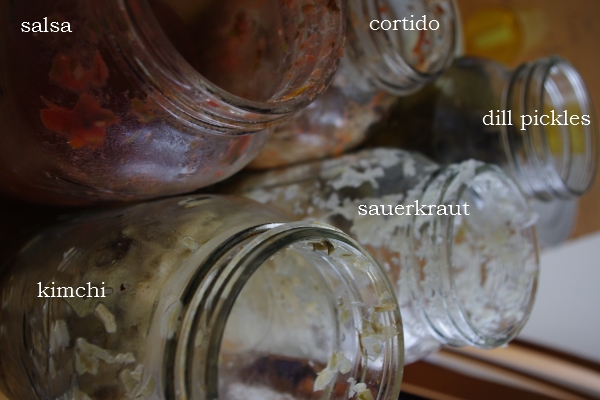
I wanted to show you how well these fermented vegetables hold up over the winter:
- Kimchi – Fermented in July (see my method here). A full 7 months old.
- Sauerkraut – Fermented in October. 4 months old.
- Cortido – Fermented in August. 6 months old.
- Dill Pickles – Fermented in July. 7 months old.
- Salsa – Fermented July – September (see my method here). 5-7 months old.
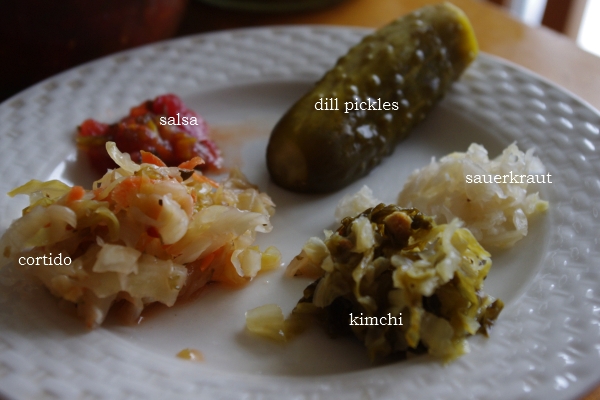
We have been eating our way through these vegetables throughout the winter and it appears as though they will bring us right up to our first harvests. You can see the various ways we use them in Simple Food {for winter}, but today I want to emphasize three things about lacto-fermentation:
- Fermented foods are infinitely more healthful than their canned counterparts.
- Fermentation is a more traditional & sustainable method of preservation that existed before water bath canning and oil were abundant.
- Fermentation is much easier and faster than canning. Like you can make a few gallons of dill pickles easily in an hour.
Clearly, though, I am not the only fan of fermentation. My friend Jenny from Nourished Kitchen wants to help people learn the lost art of fermentation through an online class called Get Cultured! Tomorrow I will share an interview with her about why fermentation is so beneficial and why even those who have been fermenting for a while can benefit from the class.
Was just wondering how much cold storage space you needed to keep these so long. I keep mine quite long, too, but always seem cramped for refrigerator space. Therefore, I don’t eat them as often as I should. This year, I want to try to grow a garden to sustain us through the year……keeping the harvest through the winter, but do not know how to store it all. Do you have an extra refrigerator, root cellar, etc??? How much space do you need for each person? Thanks for sharing your experience!!
Nina – Definitely a lot of space in my fridge was taken up with these ferments. In the fall I would say 2/3 of my refrigerator was stuffed with 1/2 gallon jars, which I almost exclusively use because they take up a little less space by being taller. Eventually I plan to store them in the root cellar, but right now I just use the one refrigerator in our rented duplex. The how much space/person is an interesting question. I also store a lot of my dried foods in a spare closet.
I really can’t wait to start lacto-fermenting again, even though, just like you, my fermented veggies from the fall are still perfectly yummy! All winter I have been enjoying lacto-fermented salsa, beets, ginger-carrots, sauerkraut, and okra. All the pickles I made only lasted a month or two (cause we ate them all!), so I am really excited to make them again! Nothing beats real old-fashioned pickles!!
I agree that the whole process is incredibly easy and satisfying. It also helps my digestion a lot… especially when I first converted to omnivorism after a lifetime of vegetarianism. It seems I didn’t have the enzymes to digest red meat especially.. but some lacto-fermented veggies would always do the trick.
Have you ever tried lacto-fermented jams? I’ve tried once, but it turned very wine-like very quickly.
Ronna – I have not tried fermenting fruit, mostly because I read it is near impossible to keep it from turning to alcohol. So I am thinking that when the time comes I will make jam, keep drying fruit, and probably make wine :).
I finished up my first foray into sauerkraut (red cabbage with a little red onion) about ten months after I started it, and it was still delicious. The new batch is white cabbage mixed with watermelon radish, so it’s bright pink! Even though I made more, it probably won’t make it ten months because it’s not competing with bought sauerkraut; we have a great live sauerkraut maker at our farmers market, but now I just buy their pickle kraut because I’m too lazy to finely slice all of those cukes.
I’ve made some beet kvass, too, and preserved lemons (and since I used up the first quart before they got too old, I’ve put up another quart, and made some for my mother, too.) The lemons aren’t quite as hardy as the veggies but they still keep for months and there are so many uses for them, especially in the seasons when I can’t get fresh local lemons.
I want to try out salsa because I won’t eat a whole jar of salsa in one go, so salsa that will keep for months in the fridge is a wonderful thought.
I lost a jar of beet kvass in the back of the fridge; it’s over a year old and still good. (Not many people like the stuff, but I love it. This batch was made from white beets, so was pale and almost clear; my husband was Slightly Grumpy when he mistook it for ice water.)
Can you tell me why occassionally my ferments which are spewing out the top of the jar on day 2-3 are dry a month later. I add extra water, but am thinking something is amiss. Thank you for this great site and your posts and your help.
I’m excited about your posts this week. I’ve tried my first attempt at lacto-fermenting recently as an experiment of sorts. I have a lot to learn and this mini series is coming at the perfect time as I plan what I want to preserve for next winter.
I really want to try. I’m just skeeeeered! 🙂
Hi Shannon. We have been having naturally fermented sauerkraut – love it! I really want to try out more fermenting recipes. I tried to click on your salsa recipe but it shows Error 404 Page Not Found? Would love to try your salsa! Thanks for sharing, Ina
Ina – Woops, thank you for telling me about that. I changed the link above to the salsa recipe here: https://www.nourishingdays.com/2011/08/how-i-make-lacto-fermented-salsa/.
Thanks Shannon – I am soooo making this salsa! 🙂
I was just wondering how you are storing or plan to store all of your lacto-fermented veggies while you are living off grid without electricity. We are in the process of going off grid, or atleast until we can afford to put up some alternative energy source, but I was wondering how to live without the fridge for all my ferments. Last fall it was packed full of ferments after the gardening season, I don’t use it for much else but don’t want to give up fermenting just so I can unplug it. Curious how you are planning to work that this year being off grid.
@Brandi, I’m having the same question and debate right now. I’m doing a lot of ferments and while I’m on grid right now, I’ll be moving to land and off grid (except for a generator) during building…and then quite likely dependent on alternative energy sources (depends on how close power is to the land we purchase).
I can’t seem to find any references to how our ancestors actually stored these ferments…IF they were really using fermentation as a food preservation technique.
Is a root cellar cool enough? Is a cool/dark place (not a root cellar) going to work?
I wish there was more information defining ‘cool’. If cool is below 60, I can handle it. If it is below 40…I’m in trouble.
@Brandi and Diana,
Vegetable ferments store well in the fall through spring here. The cooler you can keep them, the longer they will keep. I have kept jars of kraut on the counter for a month or two when the temps are 60 or below outside regularly.
I believe below 55 degrees is optimal for long-term storage. You can achieve this in a basement, cellar, or unheated room in your house, depending on the time of year and location you are in of course.
Our ancestors often buried them in the ground somewhere, which gives you a more constant and cooler temperature, but prevents freezing.
Refrigeration is absolutely unnecessary, and, as I am arguing in the book on fermentation I am currently working on, may be counterproductive. I would say, Diana, that if you can achieve below 60 then you should be able to keep them for some time, given that they were prepared properly.
Looks yummy! We are just starting to eat fermented foods and have only made water kefir so far. I will be brave and try more as the garden produces.
🙂
I have a question – how long do fermented veggies last after you open the jar they are in? I’m trying to decide if I need a lot of small jars (I’m the only one eating them) or if I can just use large 3 liter jars. if the veggies last a month or two after opening, its totally worth it to me to buy the larger jars. anyone know?
I, too, need lots of refrigerator space. I make several gallons of kvass, store several gallons of raw goat milk, and lots of kombucha along with my fermented veggies.
I have 3 extra fridges in an out building. I found some at yard sales for $50 or so. I also see an occasional free one on Craigs List.
Thanks for all the good tips here on this forum.
Thank you for your posts. I don’t understand why fermented foods require refrigeration. I think it must be to slow or stop the fermentation from destroying the food. My first foray into lacto-fermention was last year. It resulted in mushy cucumber pickles – no matter what I tried – yuk. So I tried watermelon rind because watermelon rind would benefit from some softening up. I didn’t really know how to use watermelon rind pickles – they were not great tasting but I didn’t need to spit them out. Now, I have one jar that I’ve had for a year – just gave it a try before pitching it. Yes, you guessed it – they have a lovely flavor! The acid and salt are very strong so I rinsed them in a couple of changes of water. That was when I got the nice taste. They are still too acidic so I will soak the rest in the jar which can now go in the refrigerator. I think that brine should be good starter for a new batch.
With that experience I have to wonder if things like carrots and beets require refrigeration. I don’t have the space. Any thoughts?
Laurel – They don’t! They can ferment for weeks at a cool room temperature and then be transferred to a cooler location such as a basement or cellar. Or, if your cellar is a bit warmer just ferment them there!
Do u pour brine off green tomatoes after they have fermented?
Lola – No, I do not. I will use the brine as a tonic for gut issues, though, once the tomatoes or vegetables have been eaten up.