
Make Chicken Stock in the Crock Pot
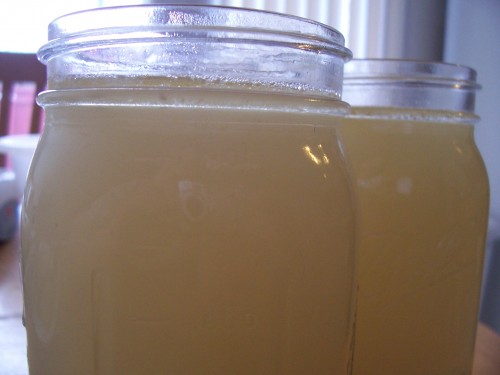
Making chicken stock is one of the first things I started doing in my journey to nourishing food. Because I’d never done it before, it seemed intimidating. It’s not. It’s easy, nutritious, and saves you money. Please don’t throw those bones away.
My first go around I tentatively used my stove top and the stock was delicious, but when it was refrigerated it came out looking like jell-o. Then I found out that that was a good thing! You want your stock to gelatinize – it means it is not only delicious, but an extremely nutritious real food as well.
After making stock on my stove top for a while I found an even easier method – the crock pot! During the summer I will sometimes roast a chicken in the crock pot itself to avoid turning on the oven. This way I don’t even have to dirty up a roasting pan and my house stays cooler at the same time. In the cooler months you should roast your chicken in the oven – crispy chicken skin anyone?
But, back to the stock – I will show you my favorite method using the crock pot. It works for me.
Crock Pot Chicken Stock
1). Every week or two I buy a whole free range, organic chicken from our farmer.
2). Roast the chicken in the oven (or crock pot in summer) and enjoy one of my favorite meals – roast chicken with vegetables and millet. For our family size we always have a good amount of leftover chicken to use throughout the week in salads, sandwiches, etc.
3). Cut all of the meat off of the bones. Place the chicken carcass and any stray bones into your crock pot. For a larger chicken (6 lbs) I use my 6 quart crock, for a smaller chicken (4 lbs) I use a 4 1/2 quart crock.
4). Add any additional vegetables you’d like – onions, celery, carrots, garlic, herbs. I like to keep a bag in the freezer of the scraps left from chopping onions and celery. I then just dump this bag in with the bones when I begin the stock.
5). Cover the bones and vegetables with cold filtered water. Cold because this allows the flavor and nutrients to be fully extracted from the bones, and filtered because you really don’t want chlorine or fluoride in their.
6). Add 1-2 tablespoons of vinegar (I usually use apple cider) and allow to sit for about an hour. You really need to do this to allow the minerals to be extracted from the bones. I let it sit while I wash dishes and clean up the kitchen. This way it is no hassle at all.
7). Turn the slow cooker to low and allow to simmer overnight. I usually let it go for about 18-24 hours.
8). Once it has cooled a bit, strain chicken stock using a colander, sieve or cheesecloth.
9). Store in quart canning jars and use in soups, stews, sauces and for cooking grains.
Vinegar != lemon juice. Different types of acid. The acetic acid converts it to calcium acetate. Your body converts it back to calcium carbonate. As far as a decent example of extreme leeching it out, toss a wishbone in a glass of vinegar and leave it covered for a few days. It’s a good joke to play on someone.
By the way, I do the same thing with veggie scraps. Instead of going into the mulch pile, it goes into a bag in the freezer. Good to hear that others do that. And I have a brita water filter I use just for water for soups, seems to do the job OK.
I can my broths, and I use a tsp of vinegar in each jar before pressure-cooker canning. The most it sat on a shelf was 3 months, didn’t go bad even with Texas heat. But I use it too often…
Ice cube trays are great if you reduce the stock really far. Keep the cubes in a ziplock and add to anything. Use it for any place that calls for white wine (deglazing) or for tomato sauce, beans, heck, just about anything.
So I am crock potting a chicken now. The juices on the bottom of them pot, is that stock?
Rebekah – Those would be called “pan juices”. Stock would be the product of covering the bones (after you remove the meat) with water and a splash of vinegar and then cook it overnight in the c.p.
I am making this now! I have it on low and am hoping that by tomorrow afternoon, I will have a delicious and nutritious stock on my hands. I can’t wait! I didn’t follow your ingredients exactly, more I just used what vegies I had on hand. If this turns out to be incredibly easy, I will kick myself for not doing this sooner 🙂 I am hoping some good bone broth will give my body a good dose of nutrients and make it ideal for baby making (gotta get the soil right before you plant the seed)!
I have just found your site. Everything I have read is just wonderful. Can’t wait to make chicken stock in the cp. We already have 90+ degree days here in NC. I’m looking forward to reading your blog every day. Thanks. Also, I am anxious to read of your new journey. Wish I had been on to this way of eating etc. earlier in my lifetime.
I made the stock, but I didn’t get very much liquid? Maybe about 5 cups…why is that? Is there anything I can do at this point?–
Angie – It depends. Was there enough water to cover the bones? Did you only use a little bit of bones? It all depends on how many bones you use. If it is a smaller chicken then you end up with a smaller amount. If, on the other hand, you simmered yours so long that the liquid is much less than what you started with then you can use it 1:1 with water as a “stock concentrate”.
This recipe turned out amazing. I do have a question though. Im new to this whole cooking thing (I am trying). After I removed the chicken I threw the bones back in the pan with the pan juices and then added water. Then added vegetables. It has been cooking on low since last night. Is this safe to eat as soup? Or are the pan juices not healthy for you? Also I didnt cool it in the fridge. Help 🙂
Thanks..
How long would a jar of stock last in the refrigerator?
I just love the idea of tossing scraps from veggies into a freezer bag! I can’t wait to start doing that. (on step 5, the last word should be “there.”) Love your post, and the many great ideas in it. Thank you for sharing.
I just made my first batch! Can’t wait to try!:) How long shall I boil when it comes time to use it?
This is delicious and healthy. We raise our own chickens — all natural & grass run. Did this with one of our turkey’s as well after our Thanksgiving Dinner. It was also delicious. Thank you for sharing!!!
Anna
I love this recipe! Thanks for sharing.
how clean do the bones need to be — how serious of a rule is this and why — thanks
If you want chicken pieces in the soup, couldn’t you just put the whole chicken in the crock pot instead of removing all the meat first? Just let it fall off the bones as it cooks? Just curious. I’m looking for a way to do this without having to take all the meat off first.
I just made this. BEST stock I have ever tasted! Wow! Thank you so much!
I have very hard water in my area. Should I add more vinegar to compensate?
I always trim all of the skin off my chicken before I cook it also. Is this something I could add to the crockpot with the bones. I never have a ton of bones since I usually buy boneless breasts so I would have to save them up in a freezer bag. Also what is the difference between stock and broth?
Thanks!
Angela
I have made stock this way for quite some time and love the convenience of it. I almost always have a pot of soup in the fridge. One of the things I particularly like to do is to chop about 1/4 cup each of cilantro and parsley and put in my bowl of soup before I pour the soup in the bowl. Both are particularly good for you and this way you get them in their raw form… bonus!
Loving your blog!
In winter, when the heat isn’t a problem ;-), roast your bones 20 min or so at 350F after the meat’s removed, include any veg you’ll be adding to make the stock – allow to cool, cover with water, add vinegar, let sit for an hour or so then crank up the crockpot or stove to simmer away and get all the goodness out. This adds another layer of flavor delight for your stock! Keep up the GREAT work!!
The clear refridgerated broth s/be gelatinous and, if the skin was included when simmering, should have a layer of chicken fat on the top. I sometimes keep the chicken fat to use, other times I don’t. Try making a brunswick stew or chicken curry with the broth and leftover chicken. I normally can get three dishes out of the one small roasted chicken if serving regular servings to my family…roasted, then curry, then soup or roasted, then brunswick, or roasted, chicken salad, and concentrated broth to freeze in ice cube trays.
Hi,
I just made the chicken stock in the crock pot, but the only thing was I didn’t have left over bones to use so I bought raw chicken drums. I cooked it overnight in the crock pot and then removed the chicken and put it in the refrigerator while I left the bones in the crock pot a couple more hours. And now I want to make chicken soup…so my question is can I used the chicken that I put in the refrigerator to cool? It smells a little weird and seems mushy
Hi, I just made the chicken stock in the crock pot…but I had bought raw chicken drums so I let it cook overnight in the crock pot and then took the chicken off the bones in the morning and put it in the refrigerator. I then put the bones back in for about 6 hours to finish the stock. But now I want to make chicken soup…can I use the chicken from the refrigerator? It kind of has a weird smell and is a little mushy?
Kris – Yes you can. Because it cooked so long the chicken might have a funny smell/texture, but it will be fine :).
Hi Shannon!
I have made your chicken stock sooooo many times and I absolutely love it! Thank you for sharing. Last night I “flattened” a chicken for the first time. Definitely not a pretty sight as I really just went with my gut instinct. Before I do it next time, I think I’ll watch a video or something. Anyway my question is…can I use the raw backbone and breastbone along with leftover roasted bones to make your stock?
Thank you!
Heather
Hi There, What to do with all that chicken fat? If my broth isn’t gelatinous, what am I doing wrong? Not enough bones? Thanks!
Just as an FYI, when I was buying my own water filter for drinking, I compared a few, and I didn’t get a Brita only because it fluoridates the water. It’s printed on the side of the box.
So, if you want the fluoride out, don’t use a Brita.
I was wondering, I am making bone broth now in the crockpot, and it reduces quite a bit. Do i just add more water once or twice? Also I have a low high and keep warm setting on my crockpot. Which setting lets it simmer?
Thanks!!
Shannon,
I just bought the book on fermented foods- fabulous. Just a question about stock- I roasted a chicken last night from the best organic, pastured chicken ever (my own LOL). I had the most amazing gel at the bottom of the pan. Can I add this to the stock I make from the bones? If not, and I want my stock to gel, how do I “prevent” this in the roasting phase? What else can it be used for? I want it in my stock. Does this make sense?
Thank you